Sunday, January 20, 2013
Assignment 1 (Abstract Piece Mimicry with Processing)
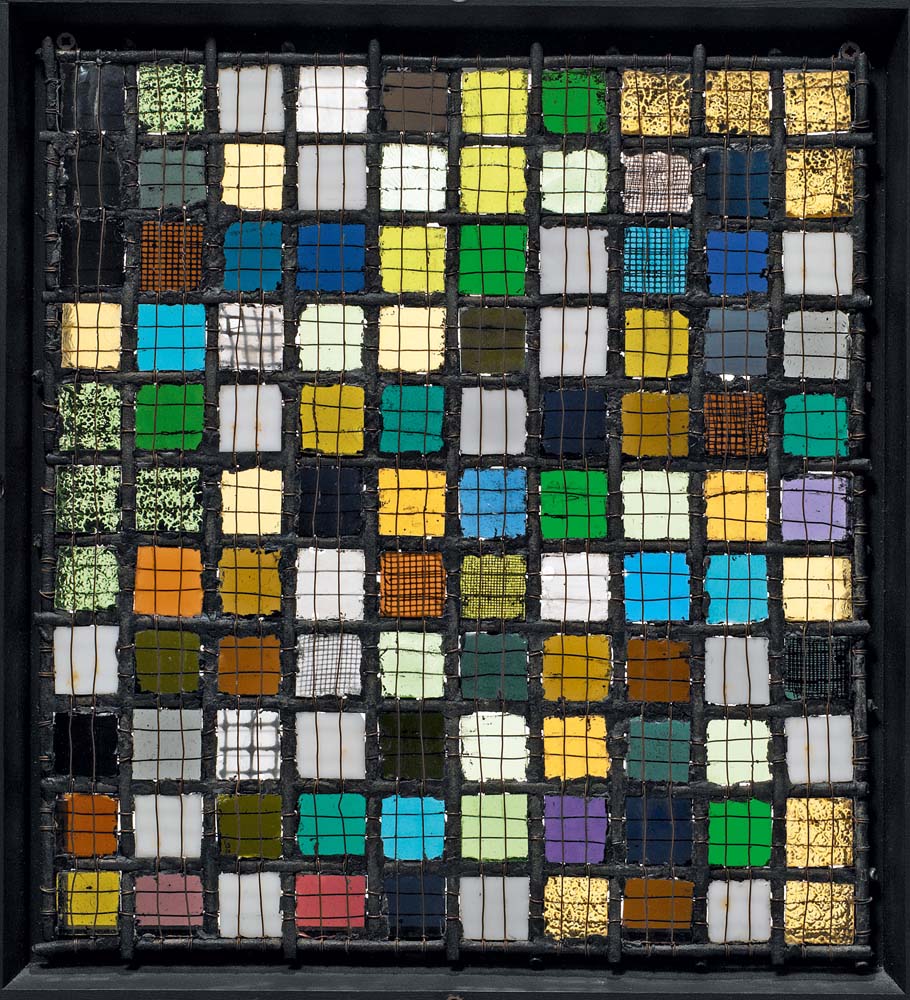
I chose a piece by Josef Albers called Gitterbild. It was made in 1921. It is a combination of glass, iron latticework, and bronze wire.
The main reason I like this piece and the reason it is in the MOMA exhibition is because of the color. You can really see how smart the original position of the squares are when you start shuffling them around. I have shuffled them around a lot of times and none of the other arrangements have looked near as good. It really shows that he knew what he was doing with his color. There is no real shape that you can make out of the squares so it allows the eye to focus more on the color. Initially I didn't know it was made of glass but knowing now it makes the piece more impressive to me. In the new realm of digital art it is hard to tell how much work a person put into their piece unless they tell you. With a piece like this one you know how much work he must have put in to making the glass and carefully putting it all together. It shows the physical skill as well as his amazing understanding of color theory. In fact he later became a teacher and had a great influence on color theory.
This is the link to his work in the MOMA exhibition: http://www.moma.org/interactives/exhibitions/2012/inventingabstraction/?work=14
Here is the link to my attempt to mimic this work with Processing:
https://www.dropbox.com/s/isg173qzdmrftwl/Assignment_1.zip
I tried to match the colors as well as I could and focused on the squares and the wire. There is some randomness to the squares that have dots on them and I randomized the angle of the wire lines to make them look bent and curved. There are some interactive features. If you mouse click it will toggle between an image of the original piece and my generated one. This allows you to easily compare the two. Also, I added a feature that allows you to scramble the squares into a new order and then you can see them move into their new positions. You press the 's' key to shuffle the squares' position values then you press and hold the 'm' key to move the pieces. It takes about 5 seconds for all the pieces to move into place. You can press the 'r' key to reset to the original placement or toggling to the original image with a mouse click will reset the placement of the generated piece.
Sunday, January 13, 2013
ISTA 401 Three Artists
I found an artist on http://www.dataisnature.com. Lucid Phantom Messenge – Herwig Weiser. I did not entirely undertsand what the piece was but it had something to do with inputing electricity into chemicals and seeing how they react. The main point is the idea of observing an autonomous process that you do not have control over. This is what interests me about the piece and about computing possibilities. When I develop games or brainstorm about what I want to do, it often involves some awesome autonomous process that makes the game unpredictable and more interesting experience.
Here is another piece I found on http://createdigitalmotion.com. It is by Peter Kirn. It is a really cool and beautiful visualization of music. This idea of visualizing music is not something super new. It reminds me of the Fantasia movies by Disney. It's very interesting how different but similar they are. I don't understand much about how this is done technically or artistically but i'm interested to try and figure it out.
This is a game from the Massachusetts Institute of Technology's Game Lab. It is called "A Slower Speed of Light". It is a basic run around and collect 100 orbs to win the game but the more orbs you pick up the slower the speed of light gets. This changes the game a lot and lets you, in a way, experience some special relativity situations and helps people understand them more intuitively. I wish I could play it. Hopefully it will be available sometime in the future. I'm interested in it because of the representation of physics in a virtual environment. I love simulations of the real world. I love playing flight simulators or anything in that venue. Here is the link to the article about the game.
ISTA 401 Introduction Post
I was homeschooled all the way up till college. I went to a community college my senior year of high school. I took their basic computer class which had a little programming at the end in Visual Basic. I really enjoyed it and that is what got me initially interested in programming. The next semester there I took a very basic C++ class which really only taught simple syntax.
Fast forward to present day and I am a senior CS major hoping to graduate this May. I have taken CS 227(java), CS 245(discrete math), CS 345(data structures and algorithms, w/ java), CS 335(More advanced java), CS 252(Assembly), CS 352(C and Unix), CS 452 (Principles of Operating Systems in C), CS 425(Computer Networking Java/C), CS 460(Databases), CS 473 (Automata/Computing Theory), and I am currently CS 466 which is Computer Security which is in C. I have a good amount of programming experience. I'm fairly confident in my technical ability.
As far as my creative abilities go I am not nearly as experienced. I wouldn't consider myself to be very creative but I am excited to see what I end up creating throughout this class.
Wednesday, December 5, 2012
Commonality between Painting and Programming
My girlfriend is an Art major and is currently taking a
painting class and I am a CS major. We were talking the other day about the
similarities between how she goes about painting and how I go about writing a
program. When I first start to work on a program I normally begin by getting a
pencil and paper. I work out how I want to represent the functionality of the
program’s purpose in code, what things go where and how different objects
relate to each other (assuming an object-oriented language). You need to know
what every object knows and how will it be interacting with the other objects.
This is all to accomplish the program’s end goal, whatever that may be. Now if
we think about a painting. When have a concept that you want to get across
through painting, normally you do not just start painting and hope it all works
out on the fly. The artist will do some sketches to figure out the composition,
colors and shapes of the painting. The artist will need to think through how
the colors relate and affect each other and how they impact the shapes.
Similarly figuring out how all the objects will relate to each other a painter
will need to understand before hand how he or she wants all the elements of the
painting to relate and affect one another in order to get across the original
concept. If you think about it more you realize the process methods for both
these things are very similar.
Program Design: Trading game
I want to talk about a game I am currently developing and
about how I generally approach more complicated programs. I’ve always really
enjoyed playing market and trading based games, games like “Taipan!” and
“Tradewinds”. The basic game concept behind these games is you buy products at
one location and then travel to another in hopes of selling it for a profit.
Seems very simple and even boring but add some potential challenges and
somewhat controlled random prices and it can become a very fun and interesting
game. I want to start my game buy having the same game concept at its core but
then I want to creatively expand the game and add more complexity. This leads
into my next topic. How do I write code without knowing where exactly the game
design is headed?
The
answer to the question above has two parts. One is you should be brainstorming
and have a vague idea of stuff you want to add later in the game and you can
plan for them. The second and most important is to program you code in such a
way that it handles general problems and not one exact problem. For example if you are looping through
a list and you know the list has 5 elements in it you can just hard code the
loop to iterate 5 times. Now what would happen if the size of your list
changes, which often happen in almost every program? Your loop would end up
breaking your code. A better way to handle this would be to dynamically
determine the size of your list before starting the loop. This way your loop
will never break at least for having the wrong number of iterations. Everything
in a program that is subject to change should be generated dynamically when
used to avoid problems. When I program I am always thinking about all the
different cases and outcomes of the code I am writing and I write it so my code
can handle them. No one gets this right the first time but that’s what
debugging is for. So my point is think about the future of your code while
writing it not just how can I get this to work for my current circumstances.
Floating Lantern Festival and Scale
This
festival is visually stunning to me. It is a great example of how something can
be really spectacular if a lot of people can work together to create something
beautiful and meaningful. Thousands of people gather together and launch
hot-air lanterns into the night sky all about the same time. I think just for
this is worth doing just for the visual alone and the sense of tradition but it
also has a spiritual and personal aspect. The lanterns can represent a prayer
being sent or it can be the bad things floating away. Whatever view you have on
spirituality somehow something like this can make you feel like it must be a
really amazing feeling to experience being there.
Branching
from a statement that I made above that it is really cool when a lot of people
gather together to accomplish a common goal. I want to discuss scale and how
that affects a piece of art. For example have one guy randomly start dancing in
a crowd and almost none will even notice and the few that do will probably not
care in the slightest, but if half the people in a crowded area stop what they
are doing and start a choreographed dance. Pretty much everyone will notice and
take some sort of interest in it. Scale seems to matter. Another example is the
Mona Lisa. You see all the pictures of it online and it is a very well done
painting but when you see it in person and it is so small and you cant see it
up close and it seems to lose it’s wow factor. Is big always better though? I
personally cannot think of an example where a piece of art is only better as it
gets smaller. There very well might be though, but scale does play a large role
in how impressive people are with a piece of art.
Image link:
Is Art Original?
Some
people say that nowadays any art that is created is referencing something in
art history. The question I am posing is more saying “Is art purely original?”
I think it is pretty obvious that a lot of art has original ideas and
perspectives, but is everything about the artwork original. By original I mean
the artist draws the information only from himself or herself. I am struggling
with this idea as I write this. It seems impossible for anything to be truly
original. It makes me want to go back to whatever the first creation happened.
If everything that we humans create in our world is based on some past
information at some point in the past we something would have to be created
without any past information. I don’t want to get into my own philosophical
believes and such but it is an interesting question. Is it possible that there
was never an initial creation? If so then it should be possible for us now to
have a truly original idea and creation. I would argue that art is not purely
original work; some credit is always due to someone else or someone else’s work
that inspired them. Would a piece of art that was inspired by a random computer
generation be original? Is a computer random generation different than being
inspired by a person? Is it different than being inspired by nature? So I guess
the real question is “Does what inspires you change the work’s originality?”
Subscribe to:
Posts (Atom)